F.E.A.R. First Encounter Assault Recon is a first-person shooter developed by Monolith Productions and published by Vivendi. It was released on October 18, 2005, with XBOX 360 and PS3 ports following in 2006 and 2007. An expansion pack, F.E.A.R. Extraction Point, was released by TimeGate Studios in October 2006. The second expansion, F.E.A.R. Perseus Mandate, was released in November 2007. A direct sequel was announced by Monolith Productions, F.E.A.R. 2: Project Origin, and was released in February of 2009. A multiplayer version of the game, F.E.A.R. Combat, was released on PC August 17, 2006.
The game's story revolves around a supernatural phenomenon, which F.E.A.R. — a fictional special forces team — is called to contain. The player assumes the role of F.E.A.R.'s Point Man, who possesses superhuman reflexes and combats an army of cloned soldiers, and at the same time uncovers the secrets of a paranormal menace in the form of a little girl.
F.E.A.R. simulates combat from a first-person perspective. The Point Man's body is fully present, allowing the player to see the character's torso and feet while looking down. Within scripted sequences, when rising from a lying position or fast-roping from a helicopter or climbing ladders, the hands and legs of the Point Man can be seen performing the relevant actions.
A prominent gameplay element is "Slow-Mo," which slows down the game world while allowing the Point Man to aim and react at normal speeds. This effect is used to simulate the Point Man's superhuman reflexes. Reflex time is represented by stylized visual effects, such as bullets in flight that cause air distortion or interact with the game's particle effects. F.E.A.R. lead designer Craig Hubbard stated that Monolith Productions' primary goal was "to make combat as intense as the tea house shootout at the beginning of John Woo's Hard-Boiled." He continued on to say that "defeating... enemies... with style" was crucial to this goal and that reflex time plays a large role in "making the player feel like an action movie hero."
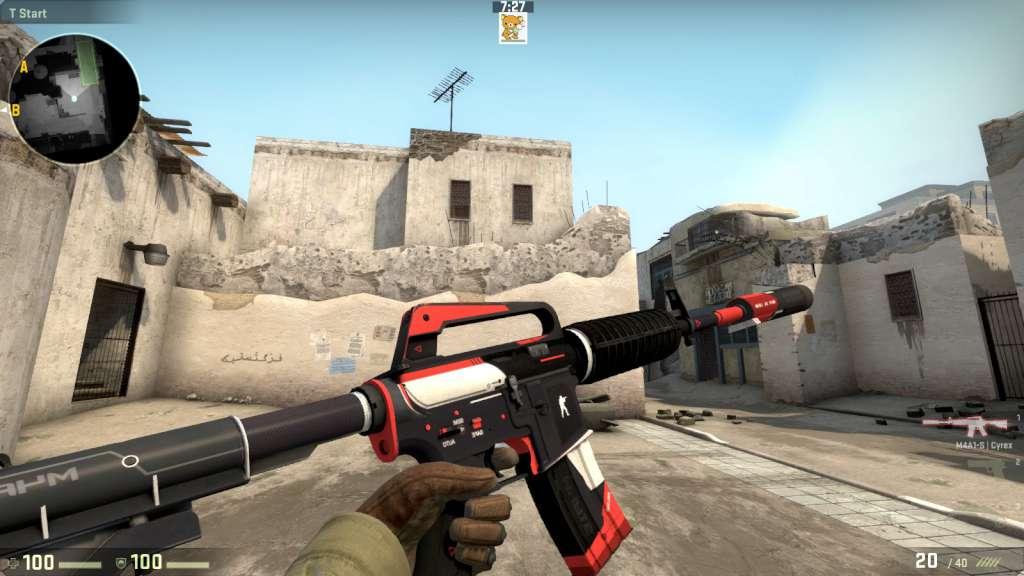
The game contains weapons based on non-fictional firearms, such as pistols, assault rifles and submachine guns, as well as entirely fictional armaments such as particle beam weapons. Each firearm differs in terms of ammunition type, accuracy, range, fire rate, damage and bulkiness. The latter characteristic affects the Point Man, as more cumbersome weapons slow his maneuvers. F.E.A.R., unlike many other FPS games, does not scale weapons on a curve, therefore any firearm is potentially dangerous in most given situations for most given enemies. Monolith Productions stated that it aimed for "a balanced arsenal where each weapon serves a specific function," rather than "just going with a bunch of real-world submachine guns and assault rifles." F.E.A.R.'s heads-up display crosshair's size dynamically shows where shots will fall based on movement, aim and the weapon in use. The Point Man may carry only three firearms at a time; thus, strategy is required when using and selecting weapons. All weapons possess mêlée attacks, and a hand-to-hand combat system allows the Point Man to attack unarmed with maneuvers including punches and kicks.
F.E.A.R. artificial intelligence allows computer-controlled characters a large degree of action. Enemies can duck to travel under crawlspaces, jump through windows, vault over railings, climb ladders and push over large objects to create cover. Various opponents may act as a team, taking back routes to surprise the Point Man, using suppressive fire or taking cover if under fire. The game's artificial intelligence is often cited as being highly advanced, and its efficiency helped the game win GameSpot's "2005 Best AI Award."
A center component of F.E.A.R. is its loathsomeness subject, which was vigorously propelled by Japanese ghastliness. The plan group endeavored to keep "the brain science of the experience" in the player's psyche consistently, with a specific end goal to "get under [the player's] skin", rather than the "in your face 'beasts hopping out of storerooms' approach". Lead originator Craig Hubbard expressed in a meeting that "repulsiveness is amazingly delicate... you can murder it by spelling things out too plainly and you can undermine it with an excess of equivocalness". He commented that he endeavored to hit an adjust with the account components of F.E.A.R., to give players "enough signs so they can frame their possess speculations about what's happening, however in a perfect world they will be left with some uncertainty". Lead level architect John Mulkey expressed, "Making desire and after that upsetting that desire is critical, consistency ruins a terrifying mood".
The fundamental wellspring of the amusement's loathsomeness is Alma Wade, a spooky young lady. Craig Hubbard commented that "a person in a cover pursuing co-eds with a meat blade can be terrifying, however in some way or another you're pondering internally you could likely beat him senseless in the event that you got the drop on him... in any case, when a spooky young lady takes out a whole Delta Force squad, how are you expected to manage that?" While Alma has been contrasted with the character Samara from The Ring (Sadako in the first Japanese), Craig Hubbard expressed that she "was resulting from a custom of shocking, faceless female phantoms" and not "as a response to a particular motion picture character". Hubbard recognized that Alma "as a matter of fact looks to some extent like the phantoms in Dark Water or Séance," however "unpleasant young ladies have been cracking him out since The Shining".
F.E.A.R's. sound was outlined in the style of Japanese thrillers, with the sound designers utilizing economical gear to make sound impacts, using strategies including dragging metal crosswise over various surfaces and recording pump sounds. Stone monument Productions remarked, "The sound creators must be worried about maintaining a strategic distance from consistency," since "listeners are brilliant ... they will perceive your recipe rapidly and afterward you won't have the capacity to frighten them any longer." Silence was additionally used with a specific end goal to "enable players to fill in the space, which gives their creative energy a chance to make their very own horror".
Stone monument Productions made F.E.A.R's. music in response to scenes, rather than "making a recipe that would reliably deliver music all through the amusement". The outline group called F.E.A.R's. music structure "more cerebral and customized to every individual occasion", and proceeded with that "occasionally the music is utilized to fasten up the strain to toy with players... will work to a frightening crescendo before cutting off without a comparing occasion, just to later have the quietness broke by Alma Wade, when players wouldn't dare hoping anymore
F.E.A.R's. awfulness topic was adulated by pundits. Diversion Informer asserted that "...the visit spooky head trips that Monolith has so skillfully woven together make an affair that requests to be played."
IGN opined that "the earth has been so all around created to keep you tense and careful... playing the diversion for a couple of hours in a row can get a little draining."
GameSpot responded comparatively, calling F.E.A.R's. ghastliness "exceedingly powerful," and concurring that it "can leave you a bit sincerely depleted sooner or later."